
May God Remember — Shemini Atzeret / Yizkor 5787

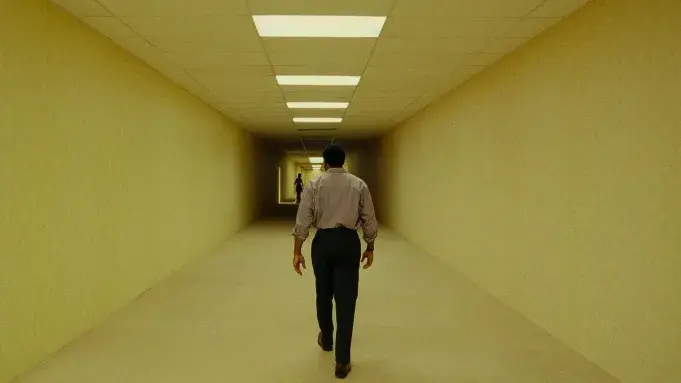
Earlier this week, I watched the movie Backrooms. If you’re not Gen Z, you may have missed this one — it was the breakthrough directorial debut of a 20 year old content creator based on a Youtube subgenre known as a creepypasta (these are words by the way I didn’t know existed until recently and never thought I would use in a sermon) — but it’s worth your time, especially if you can like movies that are unsettling, strange, and a little scary.
In the film, Chiwetel Ejiofor plays Clark, a discount furniture store manager whose life is falling apart. His marriage is in trouble, his career is going nowhere, and he’s struggling with a drinking problem. He’s having a hard time imagining that things could be different, let alone actually doing things differently. Then he discovers a mysterious portal in the wall of his store’s basement, where he’s been living since his wife kicked him out of the house. On the other side is a seemingly endless maze of rooms and corridors.
At first, these backrooms appear fairly ordinary. Think of a generic office, or a hallway in a hotel, or the storage room of a big box store, with fluorescent lights humming overhead and Muzak piped through tinny speakers. But as Clark goes further into this labyrinth, the rooms get increasingly weird – seeming at once strange and strangely familiar — everyday things that don’t quite fit together the way they should. He also encounters figures that resemble people, except that when he looks closely he begins to notice that they are off in subtle ways — too many eyes or fingers; body parts slightly askew.
The film leaves a lot unexplained. But ultimately, the movie fascinated me most as a meditation on the meaning of memory. As Clark concludes about halfway through the film, the backrooms are “every place that ever was.” They are in a sense remembered places; they’re made of memories, with all the imperfections of memories – along with the feelings that are intertwined with our memories.
Think about a room you haven’t been in for twenty years. You might remember exactly how it felt to be there, but could you tell me where every piece of furniture was? Or how many windows it had? Now imagine trying to build that room using only what you can recall. That’s what the backrooms of the movie feel like: someone has tried to construct a world from memory, and quite a bit is at least slightly off.
And as I’ve been reflecting on the film, I’ve found myself thinking about the places from our past that many of us would love to walk into again — the kitchen where someone used to cook for us, the table where we knew who would be sitting in every chair. What if we could walk into one of those rooms and find that it was still tangible as it once was? What if we could visit there once more with someone we loved and lost?
Imagine having the chance to sit down together again, to tell them what has happened since they died, or ask the question you never got to ask, including, perhaps, painful questions. Or maybe you wouldn’t need to say very much at all. Maybe it would be enough just to hear them laugh, or to have one of those completely ordinary conversations that you would now give almost anything to have.
That longing is part of what brings us here for Yizkor. We want to spend a little more time with the people we miss, to speak their names, picture their faces, hear their voices again. Some of us would gladly stay for a while in those remembered rooms. The people who made them feel like home are gone, and the world outside can be a very lonely place. Of course we would want another afternoon together. Sometimes the memory of those ordinary moments is what helps us get through the day.
We know, though, how easily longing for and idealizing the past can distort our view. Memories come back to us in pieces, shaped by what we miss and what we would rather forget. And sometimes we become so attached to the way things were that we have trouble seeing the people and possibilities right in front of us. Kohelet puts it sharply: “Do not say, ‘Why were earlier times better than these?’ For it is not wise of you to ask that question.”
That’s precisely what happens in Backrooms. Eventually, Clark goes missing and his therapist comes looking for him. She discovers the portal in the store basement, and when she finds Clark in the labyrinthine backrooms, she wants to help him get home. But Clark surprises her: he wants to stay. For all that is terrifying about the backrooms, they offer him a way to escape a future he doesn’t know how to face. Going home would mean confronting his problems and needing to change. Here, he can keep living among pieces of the past. He doesn’t want to leave, because he doesn’t want to change.
I don’t want to give too much away beyond this, so let’s just say that his past...comes back to bite him.
When yesterday becomes the only place we want to be, it can become harder and harder to live today.
But if so, then why does our tradition regularly bring us back to the realm of our memories with Yizkor? If there is a danger in trying to live in the past, why set aside sacred time to return to it? We certainly want to remember the people we love. The question is what remembering asks of us when it is time to go home.
Look closely at the Yizkor prayer. Surprisingly, it begins with the words “Yizkor Elohim — May God remember.” We come here to remember the people we love, and yet the prayer itself asks God to remember them. That raises a fairly obvious theological problem: does God forget? Does the One who knows everything need a reminder from us?
The medieval commentator Rabbi David Kimhi, usually known as Radak, takes up that question in his commentary to the biblical story of Noah. The flood has covered the earth, and Noah, his family, and the animals have spent months confined to the ark. Then the Torah says, “Vayizkor Elohim et Noah — God remembered Noah.”
Radak points out that remembering ordinarily follows forgetting: something slips our mind, and then we recall it. That cannot describe God, who already knows. The Torah, he explains, speaks in human language so that we can understand. To grasp what “God remembered” means here, we have to read what happens next: God causes a wind to pass over the earth, and the waters begin to subside. God responds to the distress of those aboard the ark, making it possible for them eventually to leave.
We use “remember” that way ourselves. When we say, “Remember what you promised,” we may be quite sure the other person hasn’t actually forgotten about their commitments. We’re asking them to follow through. The past commitment must make a difference in what they do now.
Something similar happens in the book of Exodus. Our ancestors are enslaved in Egypt, groaning beneath their burdens and crying out. God hears them and, according to the text, “remembers the covenant with Abraham, Isaac, and Jacob.” Again, it’s not that God had forgotten about those ancestors and, in so doing, failed to notice the suffering of their descendants. Rather, it’s about God’s past commitments inspiring present action; the relationship leads the movement toward liberation.
The book of Leviticus takes this idea further. Near the end of the book, the Torah describes what will happen if the Israelites violate the covenant. It is a terrible picture: destruction, devastation, exile. Then it describes those who survive acknowledging their own wrongdoing and that of their ancestors. In the midst of that painful reckoning, God promises to “remember” the ancestral covenant. Even in exile, God will not destroy the people utterly or abandon the relationship.
The nineteenth-century commentator Malbim notices a small Hebrew word, af, meaning “even,” which is repeated in the course of that promise. God will remember the covenant with Jacob, and “even” the covenants with Isaac and Abraham. Why “even”? Malbim understands it as expressing surprise. He is thinking about Abraham’s son Ishmael and Isaac’s son Esau, whose legacies he regards as troubling. Even with those legacies, God remembers the merits of Abraham and Isaac.
His reading makes me think about how we remember our own loved ones. Their legacies can include goodness and generosity alongside faults and flaws. Just as God can acknowledge the good without waving away the bad, we need not forget about what may have hurt us and yet still honor what was good. And as we consider what to carry forward and what we hope to do differently, remembering becomes part of how we shape the lives we are living now.
Notice what happens in each of these stories. God remembers Noah, and Noah and his family can eventually leave the ark. God remembers the ancestors, and their descendants begin the journey out of Egypt. Even amid the devastation of exile, God’s faithfulness means there can still be a future. God’s remembering changes what can and does happen next.
These passages help us understand what we are asking in Yizkor – for God to keep faith with our loved ones, remembering their goodness without ignoring their faults. We entrust the whole person to God, including everything we never knew and everything we still have trouble understanding.
And then the Yizkor liturgy turns from God to us, calling us to commit ourselves to deeds of kindness and righteousness like giving to tzedakah in honor of our loved ones’ memories.
Rabbi Shmuel Goldin, a contemporary Orthodox thinker, writes about this in an essay called “An Encounter with Yizkor.” He recalls how puzzled he was when he first recited Yizkor for his father: why should giving tzedakah have anything to do with God remembering him?
Goldin’s answer is that the effects of a person’s life continue after their deeds have ended. People they taught go on to teach others. People they cared for learn to care for someone else. In his understanding, God’s reckoning of a life includes those continuing effects. Our acts of goodness can add to the merit of the people whose goodness helped shape us.
Suppose someone taught us to be generous. Years after their death, we make a gift in their memory that feeds someone who is hungry or helps a family find a place to live. Our loved one never met those people. Yet something they gave us helped make that care possible. In Yizkor, we ask God to recognize that connection: this new act of goodness is linked to the person we remember. And in so doing, mere memory is transformed into a productive and purposeful and forward-facing present.
Of course, some losses are so fresh that saying these prayers is already asking a great deal. There is room here for grief that has no lesson to offer today. And some relationships leave us with wounds as well as gifts. We can bring that whole history into Yizkor, asking God to hold what we cannot resolve and to help us find our way.
In Backrooms, Clark wants to remain among remembered things because he doesn’t want to face what comes next. He gives himself over to the world of memory, and it consumes him. We can understand the longing to stay somewhere familiar, especially when the present hurts. Yizkor gives us a way to return to the past and yet come home with a commitment to the present.
Think back to that kitchen again in your mind’s eye. We can’t sit down to another meal with the person who once cooked for us there. But perhaps they taught us what it feels like to be welcomed, to be fed, to have someone make room for us. And perhaps someone at our table today needs that very care. The meal will be different. The conversation will be new. And something of the love we received will be present.
We can treasure that kitchen without trying to rebuild it exactly as it was. What mattered there can take another form, with different people, in a different room. The kindness we remember can become kindness someone experiences for the first time.
And when we ask God to remember the person who gave us that kindness, we can offer this new act of care in their name. Our remembering, just like God’s, can change what happens next, in our lives and the lives of others.
Perhaps that helps explain why we say Yizkor on festivals, during seasons of joy. We bring the people we miss into our celebrations, along with our gratitude, our questions, and our grief. We ask God to keep faith with the people we love, and we promise to help their kindness reach someone who needs it now. We will leave this room with meals still to share, people still to welcome, goodness still to give. We can honor those who made our lives possible by caring for the lives that are before us now.
So, as we prepare to say Yizkor:
May the Holy One remember all whom we have loved and lost, holding them in love and mercy, and comforting us when their absence feels unbearable.
Remember their goodness, meet their failures with compassion, and help us find healing for the wounds we still carry.
Help us receive what the past has given us with gratitude and honesty, and discover what we can do with those gifts today.
May the generosity we learned from those we remember feed someone who is hungry, the courage they gave us help someone who is afraid, and the welcome we received from them reach someone who feels alone.
And may our remembering give us strength to meet the lives before us with open hearts, so that the love we have received will continue to bring new kindness and new joy into the world.
So may it be God’s will.
Amen.


Comments